Try Latex Casting with EnvironMolds Latex Rubber

Liquid latex rubber is a popular casting material that can be easily used to make hollow rubber articles, flexible props, toys, display articles and even masks. However, things can get confusing when it comes to buying latex rubber.

In fact, art stores stock a wide range of latex casting rubber and all are not formulated in the same manner. Some latex compounds may take a long time to cure while some others may not have the necessary tear strength.


What you need to pick is high-quality latex rubber emulsions like EnvironMolds Premium Latex Casting Rubber. This multi-use liquid rubber can be easily used to make different items like imitation pottery, puppet heads, balls and other toys, props and masks. It is also appropriate for coating foams such as polystyrene, texturing and special effects for theater or video shoots.

This is a fine quality product presented by the esteemed art house of EnvironMolds. It is available in 32 oz, 1 gallon and 2 gallon buckets on www.artmolds.com. Even professional casting artists usually recommend this product for making latex mask as well as flexible props.


In fact, you can play around with this latex rubber as you wish. You can try your hand at making gloves and other thin skin products too. Or just cast them into plaster molds to make any kind of display article you want. The price is very economical and therefore will not be inhibitive.

Usages of Plaster of Paris Bandages


Widely used in the medical sector and other industries, plaster of Paris is a material that has been an influential one since the ancient days.

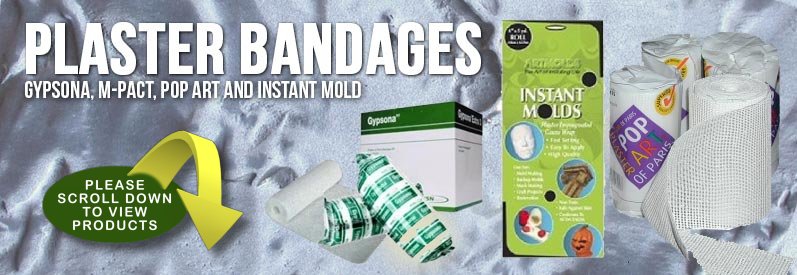
It gave forth one of the products called as plaster of Paris bandages, mainly considered as a material used to help recover fractures mainly related to bones.

Plaster bandages of a varied type are used in the medical sectors. Sterile plaster bandages are used to help supporting limbs, medical prosthesis and in forming hearing aids.
plaster bandages

The manufacturing process of these bandages is also interesting. A woven fiber is soaked into the plaster material, which is later made to dry up. Plaster bandages are also soaked in water before using. It is applied in the wet state and after administration; it solidifies and does not lose its shape.

Modeling plasters experience different usage. In Orthopedics, limbs are molded in plaster to deliver a shape of the real limbs. This is done to make artificial limbs. Plaster is also the materials to cast limbs that contributes to the fitting of medical prosthesis.
gypsona plaster bandages

If the process for making it is managed nicely with due attention, then you would get an awesome detailing and resolution in the desired cast object plaster of Paris bandages online, then consider exploring the website of EnvironMolds LLC. You can also call them at (866) 278-6653.

Why Should I Get A Life Casting Done?

A life cast is an exact portrait of a live human being. The three dimensional representation could be of the face, hands, feet, torso or even full body - but the sense of realism is always quite breathtaking! In fact, every wrinkle, dimple, fold, mole, pore and even fingerprint is clearly defined in the life cast, making it an exceptionally unique sculpture.

If you are still wondering why you should be getting a life cast made, consider the following possibilities:
  • Life casting is all about celebrating yourself – be it a chiseled body, recent weight loss or just as you always are. The life cast will capture your unique shape, form and expression and transform it into a work of art!
  • You can choose to immortalize your radiant love for each other in the form of intertwined hands. This is especially favored for celebrating an engagement, marriage or anniversary.
  • Life casting is often used to document a baby’s birth with a cast of their tiny hands or feet. You can even record the newborn’s growth with castings at regular intervals.
  • Expectant mothers love to preserve the memory of their pregnancy with a belly cast.
  • Similarly, a life cast can be used to commemorate any special occasion such as holding an award, cup or glove in the hand, a dancing pose or even a circle of hands with friends.
  • Life casting is possible with animals too. What can be sweeter than having a cast of your pet’s paw?

There’s no need to worry either, as skin safe alginates – available at Artmolds.com - make the body molding process harmless and fun!

Wax, wax and Some More Wax!

Name any kind of mold making, casting or life casting material and you will definitely find it at EnvironMolds. And it’s not just about the popular and sophisticated products here. Artmolds.com even offers basic and simple materials such as clays and waxes.

In fact, the website features a fulsome range of carving and mold making waxes. Let’s take a look at some of them:
  • Paraffin wax – This refined paraffin wax is popularly used for making candles. It works equally well for coating and sculpture engraving too. Edible variety of this wax is also added to chocolates to make them glossy and hard.
  • Pure beeswax - This sticky substance is derived from honeybees and is excellent for flavoring and glazing. It serves well for candle making and sculpture engraving too.
  • Synthetic beeswax – This manmade variation of beeswax works out cheaper. It is suitable for candles and soaps.
  • Roman casting wax – This strong and firm casting wax is used for carving and modeling small objects.
  • French casting wax – This studio blend wax is always recommended for the age-old technique of lost wax casting and helps in making precise sculptures. It remains pliable and does not get sticky.
  • Micro-crystalline modeling wax – This soft, nut-brown wax is perfect for direct modeling. It lends itself well for pulling waxes for bronze investment casting.

So, do not limit yourself to resins, silicones or plaster casting alone. Try playing with wax as this soft substance can be easily molded into any form or shape.

Gastronomy Feats with Sodium Alginate

EnvironMolds is not just limited to art supplies and materials per se. There is much more that you can easily find at Artmolds.com.

For instance, amongst the range of body mold alginates you will find a Cape Crystal Sodium Alginate as well. This organic, food grade and 100% natural product is the most dependable sodium alginate powder in the market. It is vegan, has no discernible flavor and emerges as one of the safest food additives.

Sodium alginate opens up numerous possibilities for chefs and cooks – from thickening and gelling to emulsifying, stabilizing and even texture-improving. Watch out for the interesting modernist feats in the kitchen, such as:
  • Increase viscosity of liquids to form various types of sauces, syrups, dressings, gravies, mayonnaise and pie fillings.
  • Bind meat to form nuggets, roasts, loaves and steaks.
  • Improve texture of noodles.
  • Gain the desired crumb texture and density in baked goods.
  • Prevent ice crystal formation, discourage product melt down and maintain smooth texture in ice creams and frozen desserts.
  • Above all, sodium alginate mixed with calcium salts is used to produce small caviar-like and large spheres. The gel formations have liquid inside that bursts in the mouth.
In fact, the unique and diverse properties prove useful in cream fillings, spreads, fruit products and even beer, wine and other beverages making it a must-have for all serious cooks!

Apart from this traditional materials such as clay, wax, rubber and polyurethanes are always available at EnvironMolds.

Of Different Mold Making Materials And More…

EnvironMolds presents a veritable confluence of materials that can be used to reproduce literally anything! And the website Artmolds.com is chock-a-block with mold making materials to support this claim. You will find everything from clay, wax, porcelain powder and plaster bandages to alginates, moulage, resins, rubbers and more.

Let’s take a look at some of these popular mold-making materials:
  • Clay: The non-drying plasticine clay varieties can be used for sculpting, mask making, mold making, special effects and clay animation. Sulfur-free versions and ballistic clay is also available.
  • Wax: The wide range of highly refined paraffin and bees wax are suitable for modeling, carving, candle making and sculpture engraving.
  • Porcelain powder: The ceramic powders lend themselves well for pottery applications as well as cold casting. Some of the varieties tend to hold detail well without chipping, cracking or becoming chalky.
  • Plaster bandages: These prove quite handy for making rigid shell molds to reinforce soft molds. The bandages can also be used for form molds such as in belly casting.
  • Silicone rubber: This is another versatile product that is commonly used for general mold making. There are options for making baking and cooking molds, body molds, etc.
  • Latex rubber: Liquid latex rubber proves to be an important material as it can be used to make molds of concrete and other abrasive items. The molds turn out tough, relatively inexpensive and can cast various materials. It works as an adhesive and can be used for special effects as well. 
  • Alginate: EnvironMolds offers a range of traditional alginate formulas as well as silica free and fibergel alginates for capturing molds from live human bodies. The properties vary to serve different purposes – some yield a softer set suitable for babies while another is more tear resistant and delays shrinkage.
  • Moulage: This age-old mold making material can also be safely applied on the skin. It is reusable and captures fine details very well.
All EnvironMolds’ products are of top quality, user-safe and many are biodegradable as well.

Quality Art Supplies At A Click!

John is a dedicated casting artist specializing in making silicone and resin casts. He can duplicate almost any item to perfection and it often gets pretty hard to tell the original from the cast!

He needs varied materials for his art studio and was on the lookout for a proficient art supplier who can fulfill all his requirements. He was quite fed up of the erratic supply of different stores and even considered the quality quite wanting.

At a recent art convention, a couple of his associate artists happened to recommend EnvironMolds as a reliable and consistent art supplier. They extolled both the range of products and the quality of materials.

Frankly John felt quite apprehensive about trying another new art supplier. However, going by the tremendous praise he thought of checking out the website before making a decision. 

And the moment he accessed www.artmolds.com, he just knew that this was the answer of his dreams! He was truly bowled over by the array of materials, supplies and equipment available on the website. The fibers, fillers, release agents, solvents, modeling stand and other tools and accessories that he had been looking for since months were all easily available right here!

Indeed, EnvironMolds has now become the one-stop shop for all his art needs and more. And his art is no longer limited to just silicone rubbers and polyurethane resins anymore. The website has even enticed him to try his hand at making life casts of real people!

Cast Rite Casting Stone For Plaster Casts

Plaster is a simple, cheap and easily available material. It enjoys versatile usage too – right from coating walls and making false ceilings to craft works and other projects.

Plaster is also popularly used to make molds, shell molds, casts and even life casts. However, regular plaster will not do as it is quite soft and chalky. What you need is specially treated plaster that will be durable, resist crumbling or chipping and can hold finishes well.

And this is exactly why EnvironMolds provides CastRite Art Casting Stone. This fine arts powder proves to be an excellent choice for making all types of castings – be it figurines, statuary, picture frames, restorations or life casts.

The plaster is easy to mix and simple to work with. It cures quickly to create hard casts, and yet the casts can be carved and will hold good and crisp detail. The high-definition casts have a natural bright white finish and even air bubbles are minimized as long as correct mix ratios are maintained.

While CastRite obviously cannot be applied directly on the skin, the same formula can easily be used to make shell molds, latex slip castings and backup flexible molds.

So go ahead and source CastRite powder for your plaster casting from www.artmolds.com. Enjoy the casts and life casts but be careful while mixing and pouring, as all plasters tend to heat up a bit.

Hands-On Workshops At EnvironMolds

I have been practicing my hand at mold making and casting since the past many months. The horde of information available on the EnvironMolds website has been my guiding force throughout my journey into the world of these beautiful art forms. I have accessed the various instruction sheets and videos many times and managed to learn everything from how to make a simple block mold to complex mask making and everything in between.

I have been itching to try my hand at the more intricate art of making body molds right from the live human body. While www.artmolds.com again puts a lot of information and techniques at my disposal, I wanted more hands-on learning to get me started.

I soon found that EnvironMolds offers live workshops on a variety of subjects to fulfill this particular need itself. Customer service informed me that they have a Life Casting workshop scheduled soon and were even willing to accommodate my convenience.

I immediately signed up for the workshop that was to be conducted by none other than Ed McCormick himself! The 2-day workshop opened the doors to rich learning and interaction – I gained knowledge of everything from material selection, preparation, mixing and application to demolding, repairing, plaster casting, finishing and mounting. As I worked through hand casts and face casts on a live model, I even grasped the fine details about model preparation, comfort and posing.

This dream-come-true opportunity has managed to make me adept at creating beautiful life castings!

SkinRite Silicone Rubber at EnvironMolds

EnvironMolds has emerged as the perfect place to find any and every kind of art materials. The wide-ranging compilation features a selection of exclusive and valuable products as well.

Take SkinRite 10 for instance. This ArtMolds silicone rubber can easily bring your artworks literally to life. The soft and translucent rubber is suited for varied purposes, such as:
  • It is the ideal rubber for realistic mask making.
  • It lends itself especially well for doll ‘reborning’ projects. The dolls truly look lifelike.
  • It can be effectively used for creating different kinds of special effects.
  • It can aptly simulate real skin surfaces too. In fact, this rubber is regularly used for making realistic prosthetic skin pieces.
  • Skins for robotic and animatronic figures can also be created using SkinRite 10.
  • It is used for making different types of props, especially theme park props.
  • Apart from casting arts, the same silicone rubber can also be used as a mold making material for easy demolding from severe undercuts. The molds will capture high detail and can be reused for multiple castings.
The best thing about SkinRite 10 is that it can be easily colored by adding silicone based paints. The resultant tint can imitate skin hues very well. Moreover, the silicone rubber is also stretchable and the elongation makes it further mimic the elasticity and translucency of skin.

Order your stock right away at Artmolds.com.

Now Find Ceramic Tools at EnvironMolds

Working with clay – be it on the potter’s wheel or by hand – is quite an interesting and enjoyable prospect. You are only limited by your own creativity when making ceramic items. However, you do need to arm yourself with the right tools of the trade to be able to create a complete and attractive product. In fact, an artist requires a variety of tools for everything from rolling and preparing the clay to cutting, sculpting, piercing and finally finishing the ceramic object.

Given the popularity of designing ceramics and the difficulty of finding high quality tools, EnvironMolds has recently added a Ceramics section to its website Artmolds.com.

The superior collection features hand crafted and carefully assembled tools that by top European craftsmen. Each tool designed using potter’s recommendations. They contain only the highest quality materials including selected hardwood of European beech (Fagus, sylvatica) from the Catalan forests, carbon steel forged in Barcelona and cast aluminum. They are designed to last not for years but for generations.

It includes:

  • Ceramic steel punches
  • Hole cutters
  • Potter’s ribs
  • Wheel tools
  • Trimming tool
  •  Refractory supports
  • Plaster rasps
  • Tongs
  • Funnels
  • Gauges
  • Sieves
  • Mixers
  •  Banding wheels and more
EnvironMolds’ product range includes all types of mold making and casting materials, tools and supplies for silicone casting, latex casting, resin casting, life casting and more.

Speeding Up Set Time of Plaster

As a casting artist, I feel that plaster is about the most versatile and efficient material for making both molds and casts. I use it regularly in my art studio and have even tried my hand at making life casts with the multipurpose plaster.

The only downside I face is the curing time. Indeed, art plaster takes a long time to set and cure completely – a few hours or even days at times. I often try to speed up the process with direct sun exposure, hand dryers and even baking in the microwave oven. This requires additional care as plaster can crack or spall at high temperatures. Therefore, it often gets quite frustrating to wait out the drying time, especially during humid weather.

Recently I chanced upon QwicKast Plaster and Gypsum Accelerator on the EnvironMolds website, www.artmolds.com. This accelerator claims to decrease set time to almost 8 minutes! And just a tiny amount will suffice.

I decided to give a try. All I had to do is add 1% accelerator to the plaster powder by weight and voila! The plaster cast had actually set in just 8 minutes. Adding 0.5% will bring down the set time to about 12 minutes while 0.2% require set time of around 18 minutes.

A word of caution - Use a gram scale to get the proportions right and never add the accelerator to the water first.

Apart from the useful accelerator, EnvironMolds also stocks plasters, gypsums and plaster of Paris bandages.

A Comprehensive Art Resource Called EnvironMolds!

The art of mold making and casting makes it possible to reproduce anything you wish - be it a figurine, candle, soap, jewelry or even screws, door knobs, tires and architectural details. Similarly, it is even possible to duplicate body parts or even make face masks. An extensive offerings of materials and supplies are available to the artist such as clay, wax, plaster, gypsum, alginate, resins, rubbers and more.

Armed with the right materials and techniques, even a novice can replicate almost anything. EnvironMolds, a leading manufacturer and supplier of mold making and casting products, makes it easy for us to access all kinds of materials, supplies and equipment required in mold making and casting.

In addition to the regular range of rubber, resin, alginate, plaster and other materials, the art materials company has even covered studio accessories such as chisels, mixers, rasps, brushes, containers, gloves, masks, modeling stands, vacuum chambers, turntables, pumps, mounts, name plates and more. Every small requirement is thoughtfully covered – be it fibers, fillers, release agents, paints, dyes, eyes, body parts or anything else.

What helps EnvironMolds emerge as a truly comprehensive resource for mold makers and casting artists is the broad range of instructional materials, books and videos. This is supplemented by hands-on workshops and the founder, Ed McCormick is always ready to consult with artists who are in need assistance.

The company itself functions as a complete almanac with its How-to sections, safety instructions and more. So if you want to pick up stock of silicone rubber and polyurethanes or just find out how to make a two-part mold, look no further than EnvironMolds!

Right Place to Find Mold Making and Casting Plaster

Plaster is a popular material for making molds, shell molds, casts and life casts. All you have to do is mix it with water to form a smooth paste. This will set quickly to form a hard mold or cast that can be sculpted easily.

However, regular plaster or Plaster of Paris is naturally soft and chalky. It starts peeling and cracking over time and fails to hold details well.

EnvironMolds offers specially-treated and high definition plaster powder that yield durable and high-definition molds and casts. Take a look:

  • No. 1 Pottery Plaster – This superior plaster serves well for ceramic and latex slurry molds as well as for casting decorative ceramic ware, sanitary ware, dinnerware and fine china. It should be mixed with potable water and higher water temperature will significantly reduce the setting times.
  • Dental Plaster – This white plaster forms a smooth mix and is easy to use. It is especially formulated for use in the complex field of dentistry such as articulation and flasking procedures. An advantage is that it does not harden like dental stone.
  •  Ultracal 30 – This extreme-strength gypsum cement is particularly useful when high accuracy and surface hardness are required, such as close tolerance tooling or duplicator molds.
Each of these plaster varieties is available in 5 lbs, 20 lbs and 50 lbs packages.

In addition, EnvironMolds also stocks a full range of mold making and casting materials such as alginate, polyurethanes, latex, silicone and more.

How To Embed Fiber in Alginate Molds

Alginate is every life casting artist’s dream come true. It captures detailed body molds without harming the model in any way. However, it is a soft mold and needs to be reinforced with a shell mold for it to retain the shape.

While plaster or cheesecloth will work effectively as a mother mold that keeps the alginate from flopping on itself, another problem arises. Given that alginate does not adhere to anything, how will the alginate mold and plaster bind to each other?

Artists have devised a novel means by embedding fiber in the alginate mold surface. The fibers are what will bind the plaster to the alginate, thus keeping the two molds together after demolding!

However, regular cotton fiber will not do here. EnvironMolds offers veterinary grade and fluffy Kendal cotton roll for this purpose. And you don’t have to coat the entire alginate mold surface with the cotton fiber either; just a small square will do the job!

Indeed, just cut out about a six-inch square from the cotton roll and separate it into two equal halves. The inside will have soft and fluffy fiber which should be gently patted on to the alginate surface after spraying it with an alginate retarder. A light touch is needed so as not to disturb the alginate surface. One half of the cotton pad is enough as the fibers will adhere to the plaster mold and keep them together!

EnvironMolds even offers brass name plates engraved to give the finished life cast and elegant and professional finish!

Range of Silicone Mold Rubbers

The leading art supplier, EnvironMolds provides a variety of silicone mold rubbers to suit any kind of mold making activity. This two-part RTV material has emerged as the best choice for various mold types. And there are different varieties to suit different applications, such as:

  • MoldRite 25 – This is a very popular variety as it is suitable for most general silicone mold making. It will create traditional silicone molds for figurines, giftware prototype tooling and stereolithography. It has a good shelf life, pot life of 2 hours, 40 minute working time and requires about 6 hours curing before it can be demolded. 

  • 5-Minute Mold Putty – This is your choice of silicone rubber for making molds very quickly and easily. You can make good impressions within just 5 minutes even without a mold box. The silicone mold can be cast immediately. It is suitable for food grade applications too.

  • SkinRite 10 – This is a soft and translucent silicone rubber that can be used for special effects or to simulate real skin surfaces. All it requires is a little tinting. It is apt for making realistic masks and doll reborning

  • LifeRite – If you are looking for a skin safe silicone rubber for making life casts and duplicating body parts, LifeRite is the perfect answer. The body molds will be reusable too. 

  •  BakeSil – This food safe silicone is FDA approved and can be easily used to make food molds and baking containers.

Perfect the art of making one part and two part molds to enjoy making silicone molds of almost anything!

Of One-Part, Two-Part Molds and More


As an art teacher, I am often faced with confused students who just don’t know when to make single part molds and when two or more part molds are required.
Let me clarify this uncertainty for everyone out there as well.
A one-part mold is basically a simple mold. It is used for making molds of figurines, small statues and other uncomplicated objects. Needless to say, this kind of mold is easy to make. All you have to do is fix the model to a mold box and pour or apply the mold making material all over and around it.
As the model has to be glued down in the mold box, it goes without saying that it should have at least one flat surface. It should be entirely level without any undercuts or any kind.
It follows that a shapely model with uneven surfaces and deep undercuts needs to be reproduced in parts. What it needs is a two-part or even a multi-part mold to capture all the details on all the sides. This is a complex technique that requires a lot of care and practice to master the various requirements. Parting lines, mold keys and spues also come into play here.
In sum, two part molds become requisite when a model has to be reproduced in its entirety on all sides on account of the undercuts and other details everywhere.

Bubble Buster Keeps Mold Bubbles at Bay

EnvironMolds has everything that a mold maker, life casting artist or sculptor might need and then some more. The catalog not only covers a full range of mold making and casting materials but also extends to all kinds of supplies, equipment and accessories that are routinely required by artists in their studios. The art supplies are truly varied and there’s almost nothing that can be found wanting.

Take the Bubble Buster for instance. EnvironMolds has carefully included this PVA mixture in its materials section so as to help artists cut down on the risk of bubble formation when making molds.

When making a mold, first apply a release agent on the original model before spraying a generous amount of Bubble Buster to cover the entire model. Now you can continue with the mold making and readily pour the mold material over the model without worrying about any bubbles.

The trick is that the mixture reduces the surface tension so that bubbles will not stick to the mold! The mix comes in a ready-to-use 6oz and 16 oz spray bottle.

Similarly, EnvironMolds also proffers a rich selection of brass name plates engraved in the art supplies section. You can choose from the sizes, fonts and mounting type to get a customized name plate for your artwork. This will instantly elevate your creation to a professional and gallery-like finish.

Check out your requirements at Artmolds.com.

Making a Two Part Mold

As a fledgling casting artist, I have become quite adept at capturing the form of simple objects in negative molds. All I have to do is secure the model in a box before pouring or applying the mold making material of my choice. I am adroitly able to capture the intricate undercuts and angles with clay, alginate and even resins.

Now I am just itching to move on and try my hand at making molds of more complicated objects. I picked a shapely figurine for this task and was well aware that the level of detailing all around the model required me to make two part molds.

In simple words, this means that I cannot make the mold in one go. What I need is two molds with each part capturing one half of the model before merging them into a single composite mold.

I chose plaster for this job and started by making a parting line all around the figurine. I followed an ArtMolds video that showed me how to portion off below the parting line with clay and make keys on the clay perimeter. Making a mold of the remaining half was quite easy.

Once cured, I carefully removed the clay border before making a similar mold of the other side. The video guided me on exactly how to join the two parts of the mold together and strap it securely for the subsequent casting.

The mold turned out a little shaky but I was still elated with my first attempt at two part molds!

Make Unique Jewelry the Resin Casting Way

I have recently started indulging my hobby to make unique and artistic jewelry. The techniques of resin casting are simple to use and perfect for capturing almost anything before fashioning it into a distinctive accessory.

I started with plain items like small dried leaves and beads. I used small round and oval caps and containers to pour the resin over the item. Once cured, finished and glossed over, I could easily turn them into lovely pendants and earrings. The transparent hue framing the tiny pieces did look quite exceptional and very soon people started complimenting on my accessories.

It was when various friends started asking me for the source and I saw how they really wanted to pick some exclusive items, that I considered moving my hobby to a professional level.

Now I use mold trays of varied shapes and sizes to make inventive jewelry. I have even started adding dyes to create lovely hues and effects. Buttons, stones, feathers, sparkles, you name it and I have captured it in a delightful setting. People even bring special keepsakes that they want me to make into a memento that they can display or wear as they want!

You can rest assured that every earring, finger ring, bracelet, pendant or neckpiece will be totally one-of-a-kind and almost inimitable. The style quotient is bound to zoom!