Hands-On Workshops At EnvironMolds

I have been practicing my hand at mold making and casting since the past many months. The horde of information available on the EnvironMolds website has been my guiding force throughout my journey into the world of these beautiful art forms. I have accessed the various instruction sheets and videos many times and managed to learn everything from how to make a simple block mold to complex mask making and everything in between.

I have been itching to try my hand at the more intricate art of making body molds right from the live human body. While www.artmolds.com again puts a lot of information and techniques at my disposal, I wanted more hands-on learning to get me started.

I soon found that EnvironMolds offers live workshops on a variety of subjects to fulfill this particular need itself. Customer service informed me that they have a Life Casting workshop scheduled soon and were even willing to accommodate my convenience.

I immediately signed up for the workshop that was to be conducted by none other than Ed McCormick himself! The 2-day workshop opened the doors to rich learning and interaction – I gained knowledge of everything from material selection, preparation, mixing and application to demolding, repairing, plaster casting, finishing and mounting. As I worked through hand casts and face casts on a live model, I even grasped the fine details about model preparation, comfort and posing.

This dream-come-true opportunity has managed to make me adept at creating beautiful life castings!

SkinRite Silicone Rubber at EnvironMolds

EnvironMolds has emerged as the perfect place to find any and every kind of art materials. The wide-ranging compilation features a selection of exclusive and valuable products as well.

Take SkinRite 10 for instance. This ArtMolds silicone rubber can easily bring your artworks literally to life. The soft and translucent rubber is suited for varied purposes, such as:
  • It is the ideal rubber for realistic mask making.
  • It lends itself especially well for doll ‘reborning’ projects. The dolls truly look lifelike.
  • It can be effectively used for creating different kinds of special effects.
  • It can aptly simulate real skin surfaces too. In fact, this rubber is regularly used for making realistic prosthetic skin pieces.
  • Skins for robotic and animatronic figures can also be created using SkinRite 10.
  • It is used for making different types of props, especially theme park props.
  • Apart from casting arts, the same silicone rubber can also be used as a mold making material for easy demolding from severe undercuts. The molds will capture high detail and can be reused for multiple castings.
The best thing about SkinRite 10 is that it can be easily colored by adding silicone based paints. The resultant tint can imitate skin hues very well. Moreover, the silicone rubber is also stretchable and the elongation makes it further mimic the elasticity and translucency of skin.

Order your stock right away at Artmolds.com.

Now Find Ceramic Tools at EnvironMolds

Working with clay – be it on the potter’s wheel or by hand – is quite an interesting and enjoyable prospect. You are only limited by your own creativity when making ceramic items. However, you do need to arm yourself with the right tools of the trade to be able to create a complete and attractive product. In fact, an artist requires a variety of tools for everything from rolling and preparing the clay to cutting, sculpting, piercing and finally finishing the ceramic object.

Given the popularity of designing ceramics and the difficulty of finding high quality tools, EnvironMolds has recently added a Ceramics section to its website Artmolds.com.

The superior collection features hand crafted and carefully assembled tools that by top European craftsmen. Each tool designed using potter’s recommendations. They contain only the highest quality materials including selected hardwood of European beech (Fagus, sylvatica) from the Catalan forests, carbon steel forged in Barcelona and cast aluminum. They are designed to last not for years but for generations.

It includes:

  • Ceramic steel punches
  • Hole cutters
  • Potter’s ribs
  • Wheel tools
  • Trimming tool
  •  Refractory supports
  • Plaster rasps
  • Tongs
  • Funnels
  • Gauges
  • Sieves
  • Mixers
  •  Banding wheels and more
EnvironMolds’ product range includes all types of mold making and casting materials, tools and supplies for silicone casting, latex casting, resin casting, life casting and more.

Speeding Up Set Time of Plaster

As a casting artist, I feel that plaster is about the most versatile and efficient material for making both molds and casts. I use it regularly in my art studio and have even tried my hand at making life casts with the multipurpose plaster.

The only downside I face is the curing time. Indeed, art plaster takes a long time to set and cure completely – a few hours or even days at times. I often try to speed up the process with direct sun exposure, hand dryers and even baking in the microwave oven. This requires additional care as plaster can crack or spall at high temperatures. Therefore, it often gets quite frustrating to wait out the drying time, especially during humid weather.

Recently I chanced upon QwicKast Plaster and Gypsum Accelerator on the EnvironMolds website, www.artmolds.com. This accelerator claims to decrease set time to almost 8 minutes! And just a tiny amount will suffice.

I decided to give a try. All I had to do is add 1% accelerator to the plaster powder by weight and voila! The plaster cast had actually set in just 8 minutes. Adding 0.5% will bring down the set time to about 12 minutes while 0.2% require set time of around 18 minutes.

A word of caution - Use a gram scale to get the proportions right and never add the accelerator to the water first.

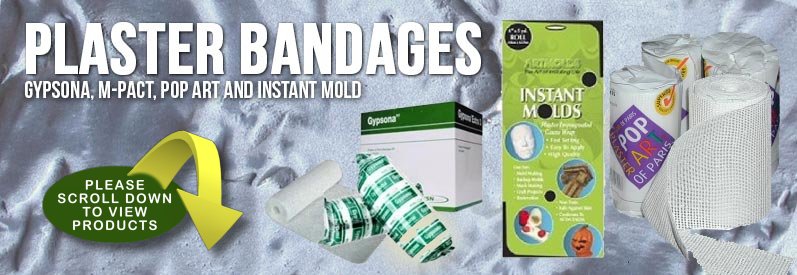
Apart from the useful accelerator, EnvironMolds also stocks plasters, gypsums and plaster of Paris bandages.

A Comprehensive Art Resource Called EnvironMolds!

The art of mold making and casting makes it possible to reproduce anything you wish - be it a figurine, candle, soap, jewelry or even screws, door knobs, tires and architectural details. Similarly, it is even possible to duplicate body parts or even make face masks. An extensive offerings of materials and supplies are available to the artist such as clay, wax, plaster, gypsum, alginate, resins, rubbers and more.

Armed with the right materials and techniques, even a novice can replicate almost anything. EnvironMolds, a leading manufacturer and supplier of mold making and casting products, makes it easy for us to access all kinds of materials, supplies and equipment required in mold making and casting.

In addition to the regular range of rubber, resin, alginate, plaster and other materials, the art materials company has even covered studio accessories such as chisels, mixers, rasps, brushes, containers, gloves, masks, modeling stands, vacuum chambers, turntables, pumps, mounts, name plates and more. Every small requirement is thoughtfully covered – be it fibers, fillers, release agents, paints, dyes, eyes, body parts or anything else.

What helps EnvironMolds emerge as a truly comprehensive resource for mold makers and casting artists is the broad range of instructional materials, books and videos. This is supplemented by hands-on workshops and the founder, Ed McCormick is always ready to consult with artists who are in need assistance.

The company itself functions as a complete almanac with its How-to sections, safety instructions and more. So if you want to pick up stock of silicone rubber and polyurethanes or just find out how to make a two-part mold, look no further than EnvironMolds!

Right Place to Find Mold Making and Casting Plaster

Plaster is a popular material for making molds, shell molds, casts and life casts. All you have to do is mix it with water to form a smooth paste. This will set quickly to form a hard mold or cast that can be sculpted easily.

However, regular plaster or Plaster of Paris is naturally soft and chalky. It starts peeling and cracking over time and fails to hold details well.

EnvironMolds offers specially-treated and high definition plaster powder that yield durable and high-definition molds and casts. Take a look:

  • No. 1 Pottery Plaster – This superior plaster serves well for ceramic and latex slurry molds as well as for casting decorative ceramic ware, sanitary ware, dinnerware and fine china. It should be mixed with potable water and higher water temperature will significantly reduce the setting times.
  • Dental Plaster – This white plaster forms a smooth mix and is easy to use. It is especially formulated for use in the complex field of dentistry such as articulation and flasking procedures. An advantage is that it does not harden like dental stone.
  •  Ultracal 30 – This extreme-strength gypsum cement is particularly useful when high accuracy and surface hardness are required, such as close tolerance tooling or duplicator molds.
Each of these plaster varieties is available in 5 lbs, 20 lbs and 50 lbs packages.

In addition, EnvironMolds also stocks a full range of mold making and casting materials such as alginate, polyurethanes, latex, silicone and more.

How To Embed Fiber in Alginate Molds

Alginate is every life casting artist’s dream come true. It captures detailed body molds without harming the model in any way. However, it is a soft mold and needs to be reinforced with a shell mold for it to retain the shape.

While plaster or cheesecloth will work effectively as a mother mold that keeps the alginate from flopping on itself, another problem arises. Given that alginate does not adhere to anything, how will the alginate mold and plaster bind to each other?

Artists have devised a novel means by embedding fiber in the alginate mold surface. The fibers are what will bind the plaster to the alginate, thus keeping the two molds together after demolding!

However, regular cotton fiber will not do here. EnvironMolds offers veterinary grade and fluffy Kendal cotton roll for this purpose. And you don’t have to coat the entire alginate mold surface with the cotton fiber either; just a small square will do the job!

Indeed, just cut out about a six-inch square from the cotton roll and separate it into two equal halves. The inside will have soft and fluffy fiber which should be gently patted on to the alginate surface after spraying it with an alginate retarder. A light touch is needed so as not to disturb the alginate surface. One half of the cotton pad is enough as the fibers will adhere to the plaster mold and keep them together!

EnvironMolds even offers brass name plates engraved to give the finished life cast and elegant and professional finish!